
You may read the poem here, where I initially found it, if you wish, before reading the analysis below.
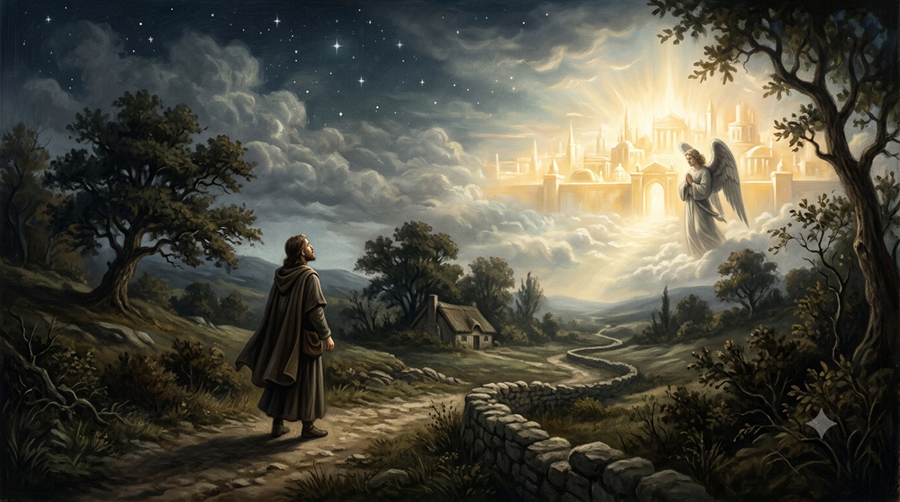
Overview
Henry Vaughan’s My Soul, There Is a Country is a short devotional poem in which the poet speaks directly to his own soul. He reminds it that this visible, changing world is not its final home. There is another “country”—the eternal kingdom and presence of God—where true peace, security, and healing are found.
At the center of that country is Jesus Christ. The poem moves from heaven as the soul’s true country, through the spiritual conflict of the present world, toward Jesus as the soul’s King, peace, security, and ultimately its life and cure. Finally Vaughan turns the message into an exhortation to himself: stop wandering among things that cannot provide lasting security and rest in the unchanging God.
The poem therefore has the character of a sermon preached to oneself. Like the psalmist who asks, “Why, my soul, are you downcast?” and then commands himself to “put your hope in God” (Psalm 42:5), Vaughan addresses his own soul and reminds it of what is eternally true.
Comments on the Poem
Stanza 1 — There Is Another Country
My soul, there is a country
Far beyond the stars,
Where stands a winged sentry
All skilful in the wars:
The opening words, “My soul,” establish the devotional character of the poem. Vaughan is not merely describing heaven; he is reminding his own soul where it belongs.
The “country / Far beyond the stars” is heaven—the kingdom and presence of God. “Beyond the stars” should not be understood as astronomy so much as spiritual imagery. Vaughan points beyond the visible created world toward a reality that cannot presently be seen.
The “winged sentry” is an angel, pictured as a guard standing watch over this heavenly country. Yet the angel is “skilful in the wars.” This introduces an important tension that runs through the poem: the destination is a country of peace, but the soul presently lives amid spiritual conflict.
Later Vaughan will describe this country as both “thy fortress and thy ease.” Christian peace, then, is not pictured as weakness or mere escape from difficulty. It is peace made secure by the power and protection of God.
Stanzas 2–3 — Jesus the King and the Triumph of Peace
In the next two stanzas Vaughan turns from the sentry to the King who rules this country. This King is Jesus Christ, whose kingdom is characterized by truth, wisdom, love, and peace.
The striking command “O leave thy sins and seek” makes the poem personal. The heavenly country is not simply something to admire from afar. The soul is called to turn away from sin and seek Jesus, its King.
Vaughan also presents Peace almost as a victorious figure. Peace does not mean that evil and conflict were never present; rather, peace has overcome them. The imagery of conflict introduced by the “winged sentry” therefore continues, but Vaughan is already showing us its outcome: the peace of Jesus Christ is victorious.
These middle stanzas provide the bridge between the heavenly country of the opening and Vaughan’s deeply personal appeal at the end.
Stanza 4 — The Flower of Peace
If thou canst get but thither,
There grows the flow’r of Peace,
The Rose that cannot wither,
Thy fortress and thy ease.
Now Vaughan describes what awaits the soul in that country.
“There grows the flow’r of Peace.” Peace becomes something living and beautiful. This is more than the absence of trouble. It is the deep and complete peace of being reconciled to God through Jesus Christ and finally at home with Him.
Then comes the lovely image of “The Rose that cannot wither.” Every earthly flower eventually fades. Vaughan deliberately gives us a flower that does not. The image contrasts the change, decay, and impermanence of earthly life with the permanence of God’s kingdom.
The Rose may also suggest Jesus Himself. Jesus is not merely the giver of this eternal peace; He is its source and embodiment. This interpretation fits especially well with Vaughan’s final description of God as “thy life, thy cure.”
The final phrase brings together two very different images:
“Thy fortress and thy ease.”
A fortress gives protection; ease gives rest. One is strong and defensive; the other gentle and peaceful. Vaughan joins them beautifully. In Jesus the soul finds both security and rest.
Stanza 5 — Stop Wandering
Leave then thy foolish ranges,
For none can thee secure
But One who never changes,
Thy God, thy life, thy cure.
The poem now turns completely inward. Having reminded his soul of the country, its King, and its peace, Vaughan tells his soul what to do.
“Leave then thy foolish ranges.” The “ranges” are the soul’s wanderings—its attempts to find lasting satisfaction and security among the changing things of this world. Vaughan tells himself: Stop wandering after things that cannot finally satisfy.
Why? Because “none can thee secure / But One who never changes.”
This is perhaps the central theological insight of the poem. Everything earthly changes. Circumstances change. Possessions disappear. Human strength fails. Even earthly life ends. Therefore the soul cannot find its ultimate security in anything subject to change.
Its security must rest in God, revealed to us in Jesus Christ—the “One who never changes.”
And Vaughan saves one of his finest lines for the end:
“Thy God, thy life, thy cure.”
The three expressions seem to become increasingly intimate.
- Thy God — the One whom the soul worships and to whom it belongs.
- Thy life — Jesus is not merely someone outside the soul who protects it; He is the source and sustainer of its true life.
- Thy cure — the restless, wandering soul needs healing, and Jesus is its remedy.
The last word is particularly powerful. Vaughan does not say merely that God provides the cure. He says that God is “thy cure.” The deepest answer to the soul’s restlessness is therefore not merely something God gives. It is God Himself, encountered in Jesus Christ.
The Movement of the Poem
The five stanzas form a spiritual progression:
- Stanza 1: Soul, remember that there is another country—your true home beyond this changing world.
- Stanza 2: That country has a King—Jesus Christ; turn from sin and seek Him.
- Stanza 3: The peace of Christ is victorious; the conflicts and powers of this world will not have the final word.
- Stanza 4: In Jesus true peace and security are found—the unfading Rose, “thy fortress and thy ease.”
- Stanza 5: Therefore, soul, stop wandering elsewhere and turn to the One who alone can secure you—“thy God, thy life, thy cure.”
Conclusion
My Soul, There Is a Country begins by directing the soul’s attention beyond the stars, but it ends by directing the soul’s attention to God Himself, and particularly to Jesus Christ. At first, Vaughan seems to be telling his soul about a place: there is another country, a secure and peaceful home beyond this world. By the end, however, we discover that the soul’s ultimate security is not simply a place to which it will someday travel. It is Jesus, a Person in whom the soul can rest.
That is the poem’s deepest movement: from country, to King, to peace, and finally to Jesus Himself.
The world changes; the soul wanders; earthly things wither. But the Rose does not wither, and the One who secures the soul “never changes.” Therefore Vaughan’s final counsel to himself is also the central message of the poem: cease looking to changing things for what only the unchanging God can provide. In Jesus Christ, the soul finds its King, its peace, its security—“thy God, thy life, thy cure.”
AI was used in developing this analysis.

