Christmas and the Spirit of Democracy was written, in 1908, by Samuel McChord Crothers.
E-book here ~ Audio reading (#23) here.
Overview
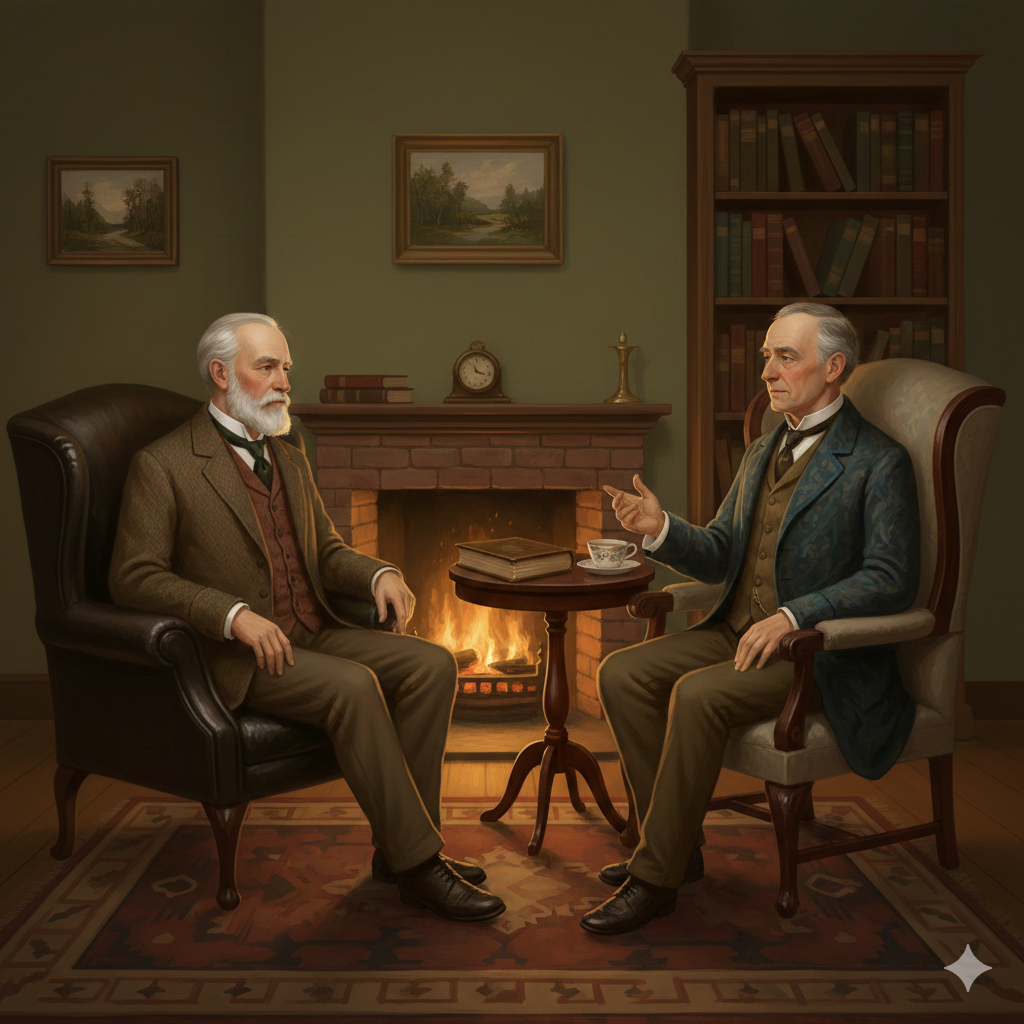
Samuel McChord Crothers’ “Christmas and the Spirit of Democracy” opens on a quiet winter evening with two men seated by a fire, talking and reading together. One of them is absorbed in Dickens’s A Christmas Carol, while the other listens, comments, and reflects. As the familiar figures of Scrooge, Tiny Tim, and the ghosts reappear in their conversation, the men begin to wonder why this story—and Christmas itself—still has such power over people’s hearts. Crothers gently leads the reader toward a larger question: what is it about Christmas that momentarily draws people together and makes them see one another differently?
Rather than treating democracy as a system of government, Crothers explores it as a spirit—a way of seeing others as equals, worthy of dignity, generosity, and fellowship. He suggests that Christmas, at its best, awakens this spirit by reminding us that human worth does not depend on status, wealth, or success, but on shared humanity. Along the way, he draws on literature, social observation, and moral insight, offering both gentle humor and pointed critique.
The essay is neither sentimental nor cynical. Instead, it challenges the reader to consider whether the goodwill of Christmas is merely seasonal emotion—or a glimpse of how society ought to function all year long. Thoughtful, accessible, and surprisingly relevant for a piece written in 1908, this essay rewards readers who enjoy ideas, moral reflection, and the way faith, culture, and public life interact and shape one another.
Central Question
Why does the spirit we associate with Christmas so naturally express the deepest moral meaning of democracy—and why is that spirit so hard to sustain the rest of the year?
Put slightly differently, the essay is not really asking about Christmas or democracy as institutions, but about a shared spirit behind both. Crothers is exploring:
- what Christmas reveals about human equality and dignity,
- why people temporarily act as if those truths matter more than rank, wealth, or power, and
- whether democracy, at its best, depends on the same moral attitude that Christmas awakens.
So the main topic is not politics in a narrow sense. It is the idea that democracy cannot survive on laws and structures alone; it requires a moral and spiritual disposition—one that Christmas vividly illustrates but society rarely maintains.
In short:
Christmas, for Crothers, is a test case that exposes what democracy truly requires to be humane, generous, and just.
Crothers’ Definition of Democracy — which is different from the common political definition.
Crothers deliberately moves democracy away from politics and into the moral life.
Instead of defining democracy primarily as:
- voting,
- representative government,
- majority rule, or
- constitutional structures,
he treats democracy as a spirit or attitude toward other people.
Crothers’ definition (in essence)
For Crothers, democracy is the habit of recognizing the full human worth of every person, regardless of:
- social class,
- wealth,
- education,
- power, or
- usefulness.
It is the conviction—often unspoken—that no one is beneath our notice and that every person is entitled to respect, sympathy, and fellowship.
How Christmas reveals this spirit
Crothers argues that at Christmas:
- social barriers are temporarily lowered,
- people feel free to show kindness across class lines,
- generosity flows not because it is deserved, but because it is human.
This, he suggests, is democracy in action, not as a political program but as a moral posture. Christmas allows people to practice democracy instinctively, without arguing about it.
The key contrast he makes
- Political democracy can exist without true human regard.
- Moral democracy cannot exist without it.
A society may have democratic institutions and still lack the democratic spirit if its people do not genuinely see one another as equals in dignity.
Why this matters to Crothers
Crothers’ concern is that democracy, when reduced to mechanics and slogans, becomes brittle. Christmas reminds us that democracy ultimately depends on goodwill, humility, and a sense of shared humanity—qualities that cannot be legislated.
In short, Crothers defines democracy not as how power is distributed, but as how people are regarded.
This needs to be continued.
I’d like a brief outline and an longer outline.

