
I came across a wonderful poem by George Herbert, titled, The Pulley. Read the text of the poem below.
Understanding George Herbert’s “The Pulley”
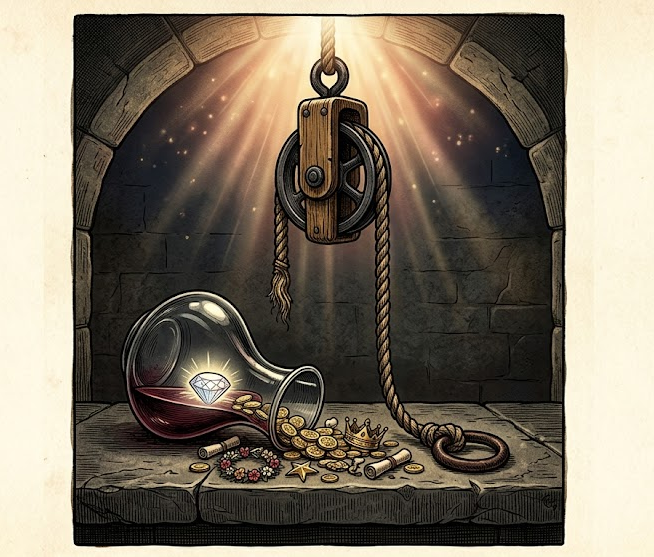
George Herbert’s The Pulley begins with a wonderfully imaginative picture of creation. God stands with a “glass of blessings” and pours his gifts upon humanity. Strength, beauty, wisdom, honor, and pleasure—all the riches that are scattered throughout the world—are gathered together, or “contract[ed] into a span,” and bestowed upon human beings (a span being the width of a human hand–small).
But just before the glass is empty, “God made a stay”—he stops pouring. One treasure remains at the bottom: Rest.
By “rest,” Herbert means more than physical relaxation. He means deep contentment: the ability to say, I have everything I need; I am completely satisfied. Herbert calls this rest a “jewel,” because it may be the most precious blessing of all.
Why would God withhold such a gift? Herbert explains:
He would adore my gifts instead of me,
And rest in Nature, not the God of Nature;
So both should losers be.
If human beings could find complete satisfaction in strength, beauty, wisdom, honor, pleasure, and the other good things of creation, we might become satisfied with God’s gifts rather than God himself. We would “rest in Nature” instead of seeking “the God of Nature.”
Then “both should losers be.” Humanity would lose because we would possess God’s gifts while missing the greatest treasure—God himself. And God would “lose” because the creatures he made for fellowship with himself would give their deepest love to his gifts rather than to him.
So God gives us many good things, but allows a certain restlessness to remain:
Ideally, God’s goodness leads us to him. But sometimes it is our weariness that does so. We discover that success, possessions, pleasure, knowledge, recognition—even genuinely good things—cannot finally satisfy the deepest longing of the human soul.
This explains Herbert’s unusual title, “The Pulley.” Just as a pulley draws something upward, our very restlessness can become the means by which God draws us toward himself. The blessings of this world are real blessings, but they cannot provide our final rest.
Herbert’s poem echoes the famous words of Augustine:
“Our heart is restless until it rests in you.”
We are meant to enjoy God’s gifts—but not to mistake the gifts for the Giver. Our deepest rest is found not in what God gives us, but in God himself.
The poem: The Pully by George Herbert
When God at first made man,
Having a glass of blessings standing by,
“Let us,” said he, “pour on him all we can.
Let the world’s riches, which dispersèd lie,
Contract into a span.”
So strength first made a way;
Then beauty flowed, then wisdom, honour, pleasure.
When almost all was out, God made a stay,
Perceiving that, alone of all his treasure,
Rest in the bottom lay.
“For if I should,” said he,
“Bestow this jewel also on my creature,
He would adore my gifts instead of me,
And rest in Nature, not the God of Nature;
So both should losers be.
“Yet let him keep the rest,
But keep them with repining restlessness;
Let him be rich and weary, that at least,
If goodness lead him not, yet weariness
May toss him to my breast.”

